
How to Prepare for Coding Interviews in 3 Months (Week-by-Week Plan)
A practical 12-week plan to prepare for coding interviews: DSA, language fundamentals, projects, mock practice and what to do the week before.

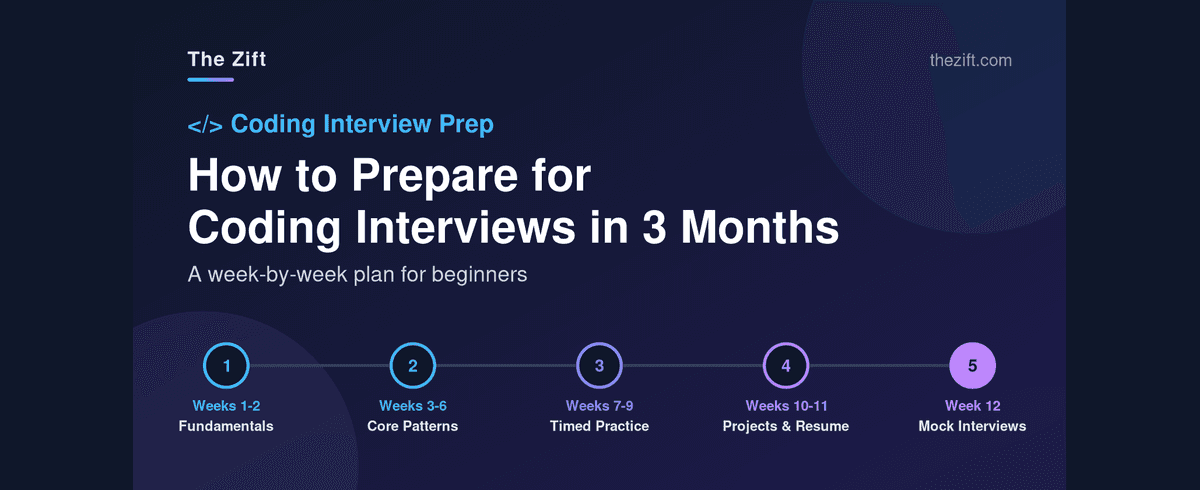
A practical 12-week plan to prepare for coding interviews: DSA, language fundamentals, projects, mock practice and what to do the week before.
If you are wondering how to prepare for coding interviews and you only have a few months, the good news is that three months is enough to build a solid base. The bad news is that random practice will not get you there. You need a plan, a steady routine and honest feedback on your progress.
This coding interview preparation plan breaks the 12 weeks into clear phases. It is written for beginners and for coding interview preparation for freshers, but it also works if you already know some programming and want more structure. By the end, you will know what to study each week, how to practise and what to do in the final days before an interview.
One honest note first: three months will not make you perfect. It will make you prepared, which is what most interviews actually require.
Coding interviews differ from company to company, but most of them test a similar set of skills.
Problem solving with data structures and algorithms (DSA) = You are given a problem and asked to write a working solution, often in a shared editor. Interviewers care about how you think, not just the final code.
Language fundamentals = You may be asked how things work in your chosen language, such as how a hash map behaves or how references work.
Core computer science basics = For many roles, expect questions on object-oriented programming, databases, operating systems and networking basics. How much depends on the role.
Projects and your resume = Interviewers often pick something from your resume and ask you to explain it in detail.
Communication and behavioural questions = Teamwork, handling problems and why you want the job are very common.
System or design thinking (for some roles) = Experienced roles may include design questions, while freshers usually see a lighter version.
Before you begin, set up three things:
One programming language = Pick the one you know best, such as C++, Java or Python, and stay with it for all 12 weeks.
One practice platform = Choose a single coding site so you do not waste time switching.
A daily time slot = Plan on about 2 to 3 hours a day, five or six days a week. If you can give less, stretch the plan to four months instead of rushing.
The first two weeks build the base. Skipping this phase is the most common reason people struggle later.
Write loops, conditions, functions, arrays and strings without looking up the syntax
Learn the built-in tools you will use constantly: arrays or lists, hash maps, sets, sorting and string methods
Understand time and space complexity (Big O) well enough to read a simple loop and estimate its cost
Get comfortable reading a problem, working through a small example by hand and then coding it
Spend the first few days on language basics and Big O.
Then solve 15 to 20 easy problems on arrays and strings. Focus on clean code and testing on small inputs.
Practise taking input and printing output correctly, because simple input mistakes cost marks in timed tests.
Start a notebook or document where you note each problem’s pattern and every mistake you make.
You are ready to move on when you can solve most easy array and string problems on your own without peeking at a solution.
This is the longest phase and the heart of your preparation. You will learn the main data structures and the patterns that repeat across interview problems.
Two pointers, sliding window and prefix sums
Binary search and basic sorting
Hash maps and sets for counting, duplicates and pair problems
Recursion and simple backtracking, such as subsets and permutations
Reversing a linked list, finding the middle and detecting a cycle
Balanced brackets and the next greater element with a stack
Queue and deque basics
Binary tree traversals: inorder, preorder, postorder and level order
Binary search tree problems, tree height and lowest common ancestor
Graph basics: how to represent a graph, then BFS and DFS
For each topic, learn the concept, trace one example by hand, then solve problems.
Aim for roughly 10 to 25 problems per topic, mostly easy and medium. It is a range, not a rule. Move on once you can solve easy problems alone and make a real attempt at medium ones.
Try each problem for 20 to 30 minutes before looking at a hint. If you read a solution, close it and write the code again from memory the next day.
Revisit older topics each week with two or three problems so they do not fade.
Dynamic programming deserves a note. Many beginners fear it, so introduce it gently at the end of this phase or the start of the next, once recursion feels comfortable. Start with simple 1D problems such as climbing stairs and house robber.
Now you move from learning topics to solving problems the way interviews present them. In a real interview, nobody tells you the topic. You have to recognise the pattern yourself.
Mix the topics = Solve problems from random topics so you practise spotting the right approach.
Add medium problems = Lean towards medium difficulty, with a few harder ones to stretch yourself.
Start timing yourself = Give yourself about 30 to 45 minutes per problem. When time is up, stop and review, even if you are not finished.
Speak out loud = Explain your approach as you code, as you would in an interview. It feels odd at first but improves quickly.
Go deeper on dynamic programming and graphs = Practise 1D and 2D DP, shortest path ideas, cycle detection and topological sort.
Read the problem and restate it in your own words.
Ask about edge cases: empty input, one element, duplicates, very large values.
Start with a simple solution, even a slow one, then improve it.
State the time and space complexity.
Write clean code and test it on a small example.
Weekly check: at the end of each week, redo three problems you got wrong. If you can solve them cleanly this time, the pattern is sinking in.
Strong coding skills help you clear the technical rounds. Projects, your resume and your communication help you win the interview. Spend these two weeks on them, but keep one or two problems a day going so your skills do not fade.
Projects
Choose two or three projects you can talk about confidently.
For each one, be ready to explain what it does, why you built it, which technologies you used, what was difficult and what you would change.
A live link or a clear GitHub README makes a project easier to discuss.
Resume
Keep it to one page if you are a fresher.
Put skills, projects and education in a clean, readable order.
Only list technologies you can answer questions about. If it is on your resume, it is fair game.
Describe what you did and what resulted, instead of just listing tools.
Core computer science basics
Spend a few hours on the topics that commonly come up for your target roles, such as object-oriented programming, database basics and SQL, operating system concepts and basic networking. Prepare short, clear answers.
Behavioural questions
Prepare answers for common questions such as:
Tell me about yourself.
Describe a project you are proud of.
Tell me about a time you faced a problem and how you handled it.
Why do you want this role?
A simple structure helps: briefly describe the situation, explain what you did and share the result. Practise saying your answers out loud until they feel natural, not memorised.
The final week is about confidence, not cramming. Do not try to learn new topics now.
Revision
Go through your notebook of patterns and mistakes. This is far more useful than starting new problems.
Re-solve 10 to 15 problems you found difficult earlier.
Review the one-line idea behind each major pattern: sliding window, two pointers, BFS and DFS, backtracking and basic DP.
Mock interviews
Do at least two or three mock interviews with a friend, a senior or a mock interview platform.
Treat them like real ones. Use a timer, explain your thinking and do not look anything up.
Ask for specific feedback on your communication, your approach and your code.
Keep a regular sleep schedule. Tired brains solve problems badly.
Do a light practice session each day instead of long, stressful ones.
Check the interview format, time and platform. If it is online, test your internet, camera and microphone.
Prepare a few questions to ask the interviewer about the team or the work.
The day before, relax. A short revision of your notes is plenty.
Without tracking, it is easy to feel like you are not improving even when you are. A few simple habits help.
Keep a problem log = For each problem, note the topic, difficulty, whether you solved it alone and the key pattern or mistake.
Track the right numbers = Count problems solved, but also note how many you solved without hints and how many you solved within the time limit.
Review weekly = Every week, look at your log and ask which topics feel weak, which mistakes repeat and what you need to revisit.
Use mock interviews as checkpoints = A mock interview at the end of week 6 and another at the end of week 9 show you how you really perform under pressure.
Adjust the plan = If a topic needs more time, take it from the next phase. A flexible plan beats a perfect one you abandon.
Progress is rarely a straight line. Some weeks will feel slow. That is normal, so keep showing up.
Is 3 months enough to prepare for coding interviews?
For most beginners, three months of steady practice is enough to build a solid foundation and clear many entry-level interviews. Tougher companies and roles may need more time. How far you get depends on your starting point and how consistently you practise.
How many hours a day should I study?
About 2 to 3 focused hours a day is a good target. Regular daily practice works better than occasional long sessions.
How many problems should I solve?
There is no magic number. A few hundred well-understood problems beat a thousand copied ones. Focus on understanding the pattern behind each solution.
Which language should I use?
Use the language you are most comfortable with. C++, Java and Python are all common and accepted. Stay with one throughout your preparation.
What if I have a job or classes at the same time?
Reduce the daily hours and extend the plan. Doing 1 to 1.5 hours a day over four or five months can work as well as 3 hours a day over three months.
Do I need to build projects as well?
Yes, especially for freshers. Projects give you something concrete to discuss and show that you can build things, not just solve puzzles.
What should I do if I get stuck on a problem in the interview?
Stay calm and keep talking. Explain what you have tried, work through a small example and ask clarifying questions. Interviewers usually give hints and care about how you handle being stuck.
What if I fail an interview?
It happens to almost everyone. Write down the questions you remember, find out where you were weak and add those topics to your next practice cycle. Each interview teaches you something.
You do not need to feel ready to begin. Pick a start date, set your language and platform, and begin Week 1 with fundamentals and Big O. Practise each phase with coding problems and quizzes on The Zift, log your mistakes and review them every week. Three months from now, you will be glad you started today.