
DSA Roadmap for Beginners: Where to Start and What to Learn Next
A clear order for learning data structures and algorithms: topics, time per topic, practice targets and common mistakes for beginners.

A clear order for learning data structures and algorithms: topics, time per topic, practice targets and common mistakes for beginners.
Most people who search for a DSA roadmap for beginners are in the same spot. They know data structures and algorithms matter for interviews and placements, but they do not know where to begin. So they open a random video, solve a few problems, hit a wall, and quit.
The problem is rarely ability. It is order. DSA is a staircase, and each topic leans on the one before it. If you learn trees before recursion, or graphs before you are comfortable with arrays, everything feels harder than it should.
This guide shows how to start DSA from scratch in the right order. You will see what to learn first, how many problems to solve on each topic, how to study a topic properly, and a sample 12-week plan you can adapt to your own schedule.
Short answer: for many roles, yes. For all roles, it helps.
A lot of companies, especially large product companies and campus placement drives, use DSA problems to test how you think. They want to see whether you can break a problem down, pick a sensible approach and write clean code under time pressure.
That said, it depends on the job:
Campus placements and big tech interviews: DSA is usually a core part of the process, so a solid DSA roadmap for placements is worth the effort.
Startups and service roles: The weight on DSA varies. Some focus more on projects, system knowledge or a take-home task, but basic DSA is still a common screening step.
Day-to-day work: You will rarely implement a red-black tree at work, but thinking in terms of the right data structure for the job makes you a better developer.
So if you are aiming for a developer job, learning DSA is a good investment, even if some interviews will not go deep into it.
You do not need to be an expert, but you need a few basics so you can focus on the ideas instead of the syntax.
1. One programming language, comfortably
Pick one language and stick with it. C++, Java and Python are the usual choices.
C++: Fast and popular in competitive programming, with the STL covering many structures.
Java: Common in placements, with a solid collections library.
Python: Short, readable code, which suits beginners well.
The best language is the one you can write loops, functions, conditions and basic input and output in without looking things up.
2. Basic maths
School-level maths is enough: arithmetic, simple algebra, powers and a feel for what a logarithm is. You do not need advanced maths to start.
3. Time and space complexity
Learn Big O notation early. You should be able to look at a loop and say roughly how its running time grows as the input grows. The common ones are O(1), O(log n), O(n), O(n log n) and O(n²). Almost every later topic builds on this.
4. A place to practise
Choose one coding platform and use it regularly. Switching between five sites is a common way to lose momentum.
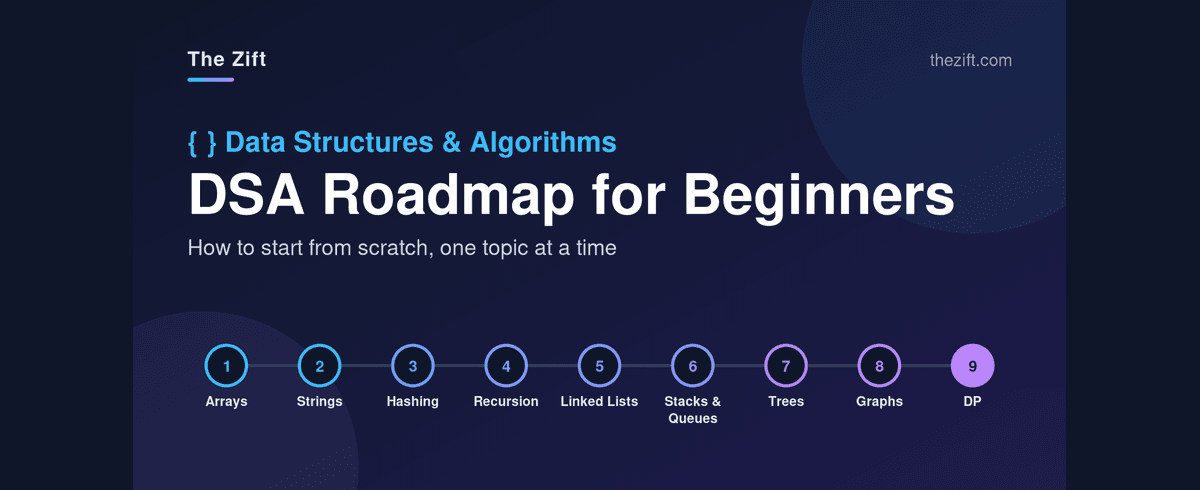
This is the core of the data structures roadmap. Follow the order, because each step prepares you for the next.
1. Arrays
The foundation of everything. Learn traversal, insertion and deletion, prefix sums, the two-pointer technique and the sliding window. Also learn basic sorting and binary search here, since they pair naturally with arrays.
2. Strings
Strings behave like arrays of characters, so they come next. Practise reversing, palindromes, anagrams, substring problems and simple pattern matching.
3. Hashing (hash maps and sets)
Hash maps turn many slow solutions into fast ones. Learn frequency counting, finding duplicates, pair-sum problems and grouping.
4. Recursion and backtracking basics
Recursion is the idea that confuses most beginners, and it unlocks trees, graphs and dynamic programming. Start with simple cases like factorial and Fibonacci, then move to subsets, permutations and basic backtracking. Spend extra time here.
5. Linked lists
Learn singly and doubly linked lists, reversing a list, finding the middle, detecting a cycle and merging two lists. These problems train you to handle pointers carefully.
6. Stacks and queues
Learn how each works and where to use it: balanced brackets, next greater element, monotonic stacks, queue using stacks, and the double-ended queue (deque).
7. Trees
Start with binary trees and traversals (inorder, preorder, postorder and level order). Then cover binary search trees, height and depth, lowest common ancestor, and heaps and priority queues. Your recursion skills pay off here.
8. Graphs
Learn how to represent a graph (adjacency list and matrix), then breadth-first search and depth-first search. After that, look at shortest-path ideas, cycle detection, topological sort and the disjoint set union.
9. Dynamic programming (DP)
Save DP for last. It is the topic most beginners fear, but it is far easier once recursion is solid. Start with the idea of overlapping subproblems, then do 1D problems (climbing stairs, house robber), then 2D problems (grid paths, longest common subsequence) and the knapsack pattern.
Where do sorting and searching fit? Learn binary search and the main sorting algorithms alongside arrays. They show up everywhere.
You will see claims like "solve 500 problems and you are ready". There is no magic number, because 50 problems you understood deeply beat 200 you copied. Use these ranges as a guide and adjust to how confident you feel.
You will see claims like "solve 500 problems and you are ready". There is no magic number, because 50 problems you understood deeply beat 200 you copied. Use these ranges as a guide and adjust to how confident you feel.
Arrays: 20 to 30 problems, mostly easy with a few medium.
Strings: 10 to 15 problems, easy to medium.
Hashing: 10 to 15 problems, easy to medium.
Recursion and backtracking: 10 to 15 problems, easy first and then a few medium.
Linked lists: 10 to 12 problems, easy to medium.
Stacks and queues: 10 to 15 problems, easy to medium.
Trees: 20 to 25 problems, easy to medium.
Graphs: 15 to 20 problems, mostly medium.
Dynamic programming: 20 to 30 problems, easy to medium.
A simple rule: move on when you can solve easy problems on a topic without help and attempt medium ones with a reasonable chance. If you are stuck on a topic, do a few more problems before moving on. If a topic feels easy, do not stay there just to hit a number.
The way you study matters as much as what you study. Use this four-step loop for every topic.
1. Concept
Learn what the data structure or technique is, why it exists and how it works. Draw it on paper. If you cannot explain it in plain words, you have not understood it yet.
2. Example
Walk through one or two solved examples by hand. Trace the code line by line with a small input and watch how values change.
3. Practice
Solve problems on your own. Try for at least 20 to 30 minutes before looking at a hint. When you do get stuck, read a hint, not the whole solution, and then try again. After solving, write down the pattern in your own words.
4. Revisit
Come back to the same topic after a few days and again after a few weeks. Re-solve problems you got wrong. This is how knowledge moves from short-term to long-term memory, and it is the step most beginners skip.
Keep a small notebook or document with each problem's pattern and the mistake you made. Reading it before an interview is far more useful than rereading a textbook.
This DSA study plan assumes about 1.5 to 2 hours a day, five or six days a week. If you have less time, stretch each phase. If you have more, shorten it. Use it as a template, not a rulebook.
Week 1: Language basics and Big O. Goal: write loops and functions comfortably and read simple time complexity.
Weeks 2 to 3: Arrays, sorting and binary search. Goal: use two pointers, the sliding window and prefix sums.
Week 4: Strings and hashing. Goal: handle frequency counting and anagram-style problems.
Week 5: Recursion and backtracking. Goal: trace recursive calls and solve subsets and permutations.
Week 6: Linked lists. Goal: reverse a list, find the middle and detect a cycle.
Week 7: Stacks and queues. Goal: solve bracket, monotonic stack and queue problems.
Weeks 8 to 9: Trees and heaps. Goal: know all traversals, BST problems and heap basics.
Week 10: Graphs. Goal: use BFS and DFS on basic graph problems.
Week 11: Dynamic programming. Goal: solve 1D and simple 2D DP problems.
Week 12: Revision and mock interviews. Goal: re-solve your weak topics and practise timed problems.
Weekly rhythm that works well
Days 1 to 3: Learn the concept and solve easy problems.
Days 4 and 5: Solve medium problems and write down patterns.
Day 6: Revise the week's mistakes and re-solve two or three problems.
Day 7: Rest. A break helps your brain consolidate what you learned.
Twelve weeks will give you a solid base, not mastery. Many people continue practising for several more months, especially when preparing for tougher interviews. The goal of this plan is to take you from zero to comfortable.
Watching without practising. Videos make everything look easy. Real learning happens when you struggle with a problem yourself.
Jumping to hard topics too early. Starting with DP or graphs before mastering arrays and recursion is the fastest way to feel lost.
Reading solutions too quickly. If you look at the answer after five minutes, you skip the thinking that builds skill. Struggle a little first.
Chasing a problem count. Solving 300 problems without reflection helps less than solving 100 and learning the pattern behind each one.
Ignoring time and space complexity. Always ask how fast your solution is and whether it can be improved.
Never revisiting old problems. Without revision, you forget topics within weeks.
Switching languages and resources constantly. Pick one language, one main course or book, and one practice platform. Stay with them.
Skipping the dry run. Test your code on a small example by hand before you submit. It catches many bugs.
Comparing yourself to others. Everyone moves at a different speed. Compare yourself with last month's you.
How long does it take to learn DSA from scratch?
With steady practice, most beginners build a good foundation in about 3 to 4 months. Being comfortable with medium-level interview problems usually takes longer. It depends on your starting point and how many hours you put in each week.
Which language is best for DSA?
The one you already know best. C++, Java and Python are all fine. Choose one and stay with it so you can focus on concepts.
Do I need to be good at maths for DSA?
No. Basic maths and logical thinking are enough for most of DSA. Some advanced topics use more maths, but you will not need them as a beginner.
Can I learn DSA without a computer science degree?
Yes. DSA is learnable by anyone who practises consistently. Many people from non-CS backgrounds learn it well through self-study.
How many hours a day should I study DSA?
One to two focused hours a day is enough for most beginners. Regular, consistent practice beats long, irregular marathons.
Should I solve problems on one platform or many?
Start with one. Once you are comfortable, you can try others for variety. Quality of practice matters more than the number of websites.
Is DSA enough to get a job?
DSA helps you clear coding rounds, but employers also look at projects, communication and core subject knowledge. Treat DSA as one important part of your preparation, not the only one.
What if I get stuck and feel like giving up?
That feeling is normal and usually means you are learning something hard. Take a break, revisit the concept, try an easier problem on the same topic, then return. Progress is rarely smooth.
You do not need to learn everything at once. Pick the DSA roadmap on The Zift, start with arrays and Big O, and practise each topic with coding problems and quizzes before moving to the next. Show up regularly, review your mistakes, and the staircase gets easier to climb.