
Best platforms to practice coding for beginners in india
Compare popular coding practice platforms by difficulty, learning curve and goals, and see which suits a beginner preparing for jobs in India.

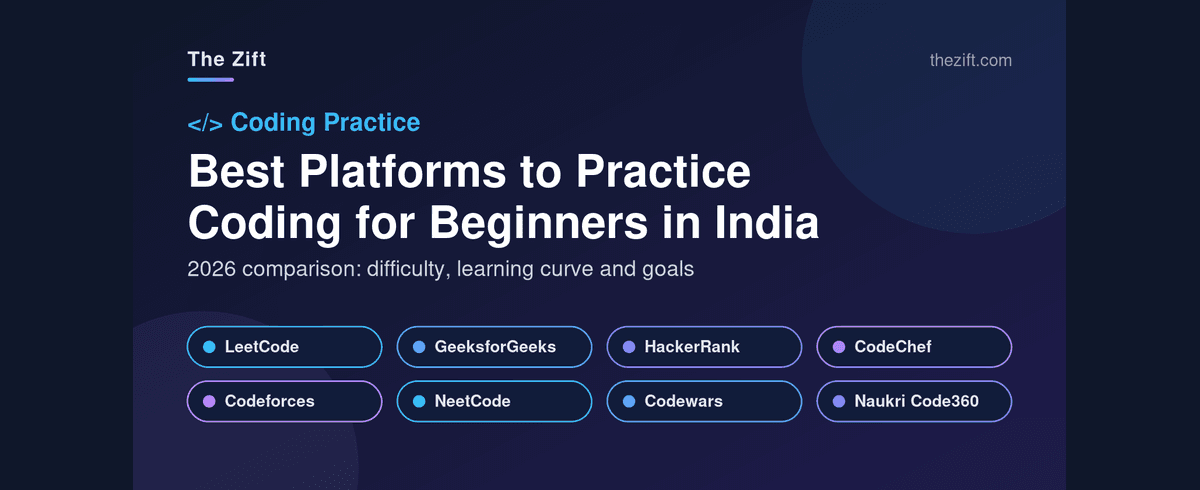
Compare popular coding practice platforms by difficulty, learning curve and goals, and see which suits a beginner preparing for jobs in India.
If you are just starting out, the hardest part of practising code is not the coding. It is choosing where to practise. Search for the best platforms to practice coding and you will find a dozen lists that all disagree with each other. Beginners end up signing up on five websites, solving three problems on each and quitting by week two.
This guide compares the most popular coding practice websites for beginners by what actually matters: the kind of problems, how gentle the difficulty curve is, language support, community and cost. It is written with students and freshers in India in mind, especially anyone preparing for placements and campus drives. It also covers popular LeetCode alternatives, and ends with a simple way to combine two platforms without burning out.
A quick note before we start: features, prices and free limits change often. Treat this article as a starting point and check each platform's own website before you commit.
The best platform is not the most famous one. It is the one that matches your stage and your goal. Ask yourself these questions.
Does it match my level? A platform full of hard problems will feel discouraging in your first month. Look for a clear "easy" tier and topic-wise problem lists.
Does it support my language? Make sure it supports C++, Java, Python or whichever language you use.
Does it teach, or only test? Some sites assume you already know the concepts. Others pair explanations with problems. Beginners usually need a bit of both.
Is the free version enough? You should be able to practise seriously without paying. Paid plans can help later, but they should not be a starting requirement.
Does it have solutions and discussion? Reading how others solved a problem you were stuck on is a big part of learning.
Does it fit my goal? Placements and interviews need DSA practice and company-style questions. Competitive programming needs contests. Web development needs projects and challenges. Pick based on what you are actually aiming for.
If you remember only one thing, remember this: the right platform is the one you will open every day.
Here is a side-by-side look at the main options, one platform at a time. The same five criteria are covered for each.
LeetCode
Problem types: Algorithm and data structure problems in interview style, with topic and company tags.
Difficulty curve: Easy, medium and hard labels. Many beginners find even the easy tier steep at first, so it works best once you know the basics.
Language support: Supports many popular languages, including C++, Java and Python.
Community: Large, with an active discussion section and regular contests.
Cost: A free tier covers a large set of problems. A paid Premium plan adds extras such as company-wise lists, and is more useful close to interviews than at the beginning.
GeeksforGeeks
Problem types: DSA problems alongside written tutorials, topic pages and interview experiences, with a daily problem feature.
Difficulty curve: Gentle. Because concepts are explained next to the practice problems, it suits beginners learning DSA from scratch.
Language support: Covers popular languages such as C++, Java and Python.
Community: Very widely used by students in India, with lots of placement-focused content.
Cost: Free core content and practice, plus paid courses.
HackerRank
Problem types: Language-specific tracks (such as Python, SQL and problem solving) plus interview preparation kits.
Difficulty curve: Beginner-friendly tracks that start with the basics of a language and progress step by step.
Language support: Wide support across many languages.
Community: Active, and often used by companies for online assessments, so the format is useful to get used to.
Cost: Free for learners, with paid plans mainly aimed at companies.
CodeChef
Problem types: Competitive programming with regular contests and a large practice archive, plus DSA learning paths.
Difficulty curve: Beginner to advanced. Contests can feel intimidating at first, so start with the practice section.
Language support: Supports many languages.
Community: Especially popular in India, with a lively contest culture.
Cost: Free for practice and contests.
Codeforces
Problem types: Competitive programming contests with a huge archive.
Difficulty curve: Steep. Better for intermediate learners than for absolute beginners.
Language support: Many languages.
Community: Strong global competitive programming community.
Cost: Free.
NeetCode
Problem types: Curated lists of interview problems grouped by pattern, with video explanations.
Difficulty curve: Very beginner-friendly because problems come in a sensible learning order.
Language support: Videos and solutions mainly follow popular languages such as Python, Java and C++. Check the site for the full list.
Community: Large following among interview preparers.
Cost: Many roadmaps are free, and a paid Pro tier exists for extra content.
Codewars
Problem types: Short coding challenges called katas that build language fluency rather than interview skills.
Difficulty curve: Starts very easy, so it is good for building basic coding confidence.
Language support: Supports many languages.
Community: Friendly, with a rank system and solution comparisons.
Cost: Free.
Naukri Code360
Problem types: Guided DSA paths, practice problems and interview-oriented content.
Difficulty curve: Structured, topic-wise progression that suits beginners who like a clear roadmap.
Language support: Popular languages are supported.
Community: Smaller than the platforms above, but India-focused.
Cost: Offers free content alongside paid courses.
Here is the short version of who each platform suits best. Before you sign up, open the platform's own website to confirm its current features and pricing.
GeeksforGeeks is a good starting point if you are new to DSA and want explanations next to problems. It is also strong for placement-style practice.
HackerRank is good for learning a language step by step and for getting used to online assessment formats.
LeetCode is the standard choice for interview-style DSA practice. Start it once you know the basics of arrays, strings and hashing, and use the free tier first.
NeetCode is useful if you want a clear order to solve interview problems in, with video help.
CodeChef is a good choice if you enjoy contests and want an India-friendly competitive programming community.
Codeforces is best saved for later, once you are comfortable and want tougher contests.
Codewars is handy for short daily exercises that improve your fluency in a language.
Naukri Code360 suits learners who want a guided DSA roadmap.
You do not need all of them. Most beginners do well with one learning-focused platform and one problem-solving platform.
The Zift is where you can follow roadmaps and then practise what you learn. Its practice section has coding problems and quizzes that go alongside each stage of a roadmap, so you can go from "I read about arrays" to "I solved array problems" without leaving the site.
We are not trying to replace the platforms above. If you already use LeetCode, GeeksforGeeks or CodeChef, you can keep using them. Think of The Zift as an extra place to:
Follow a beginner-friendly roadmap in a sensible order
Test yourself with quizzes after each topic
Get regular practice with coding problems alongside your main platform
As the people who run The Zift, we are naturally biased, so judge it by trying it out for yourself.
Using two platforms can help, because each does something the other does not. Using four is how people burn out. Follow these simple rules.
1. Give each platform a clear job
Platform one is for learning and structured practice, such as GeeksforGeeks, NeetCode or The Zift.
Platform two is for problem solving at scale, such as LeetCode, HackerRank or CodeChef.
2. Follow a simple weekly rhythm
Early in the week, learn one topic on your learning platform and solve easy problems.
Mid-week, solve a few medium problems on your second platform.
At the weekend, revise the mistakes you made and re-solve two or three problems. Take a proper rest day.
3. Set a daily limit
One to two focused hours a day beats a six-hour weekend binge. Stop at the limit, even when you are on a roll.
4. Stay with a topic until it clicks
Do not jump between platforms every time a problem feels hard. Hard is the point. Try for 20 to 30 minutes, read a hint, then try again.
5. Keep one notebook
Write down patterns and mistakes in one place, no matter which platform you used. This is your real progress tracker.
6. Avoid platform hopping
Switching platforms feels productive, but it often means starting from the easy tier again. Give your choice at least a month before you decide it is not working.
7. Track time, not just problem count
Counting solved problems encourages rushing. Counting honest practice hours encourages understanding.
Which is the best platform to practice coding for beginners in India?
There is no single best choice. GeeksforGeeks and HackerRank are friendly starting points, and LeetCode or NeetCode work well once you know the basics. Pick one and stay with it for a few weeks.
Is LeetCode good for beginners?
LeetCode is excellent for interview preparation, but it can feel hard in your first weeks. It works best after you learn the basics of a language and simple data structures. Start with the easy problems and use its topic filters.
Do I need to pay for any coding practice platform?
No. You can practise a lot on the free tiers of most platforms. Paid plans can be worth considering later, especially near interviews, but check the current price on the platform's own website first.
What are good LeetCode alternatives?
Popular alternatives include GeeksforGeeks, HackerRank, CodeChef, Codeforces, NeetCode and Naukri Code360. Each has a different focus, so pick the one that fits your goal.
Where can I practise coding online for placements?
GeeksforGeeks, HackerRank, LeetCode and CodeChef are commonly used for placement preparation in India. Practise DSA topics and also get used to timed online tests.
How many platforms should a beginner use?
Two is enough: one for learning and structured practice, and one for solving more problems. More than that usually leads to scattered effort.
Which language should I use for practice?
Use the language you are most comfortable with. C++, Java and Python are all supported on the major platforms. Stay with one language so you can focus on concepts.
How often should I practise?
Daily practice of one to two hours works better than occasional long sessions. Take at least one rest day a week.
You do not need the perfect platform. You need a consistent habit. Try the practice section on The Zift alongside whichever platform you already use, and keep a simple log of what you solve and what you get wrong. A month from now, that log will show how far you have come.